TYPES of BEARS

Bears are carnivoran mammals of the family Ursidae. They are classified as caniforms, or doglike carnivorans. Although only eight species of bears are extant, they are widespread, appearing in a wide variety of habitats throughout most of the Northern Hemisphere and partially in the Southern Hemisphere. Bears are found on the continents of North America, South America, Europe, and Asia. Common characteristics of modern bears include large bodies with stocky legs, long snouts, small rounded ears, shaggy hair, plantigrade paws with five nonretractile claws, and short tails.

Bear close up

Ailuropodinae

Ailuropodinae is a subfamily of Ursidae that contains only one extant species, the giant panda (Ailuropoda melanoleuca) of China. The fossil record of this group has shown that various species of pandas were more widespread across the Holarctic, with species found in places such as Europe, much of Asia, North America and even Africa. The giant panda is the most herbivorous living bear species and has had an omnivorous diet that by around 2.4 million years ago, pandas had evolved to be more herbivorous. The giant panda (Ailuropoda) belongs to the order of Carnivora, this means that the macronutrients that are digested are most similar to those of carnivores than to that of herbivores even though their diet consists mainly of bamboo.
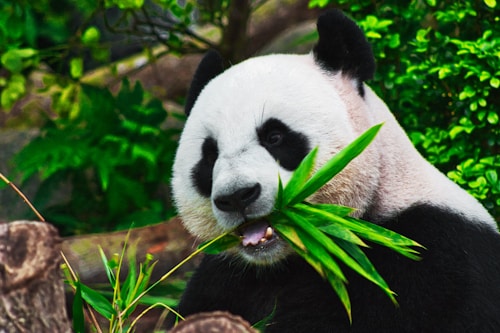
Giant Panda
Panda eating

Tremarctinae

Bear in nature

The Tremarctinae or short-faced bears is a subfamily of Ursidae that contains one living representative, the spectacled bear (Tremarctos ornatus) of South America, and several extinct species from four genera: the Florida spectacled bear (Tremarctos floridanus), the North American giant short-faced bear (Arctodus simus), the South American giant short-faced bear (Arctotherium) and A. angustidens. A. vetustus, A. bonariense, A. wingei, and A. tarijense) as well as Plionarctos (P. edensis and P. harroldorum), which is thought to be ancestral to the other three genera. Of these, the giant short-faced bears (Arctodus simus and Arctotherium angustiden) may have been the largest ever carnivorans in the Americas. The group is thought to have originated around 5 million years ago and then invaded South America as part of the Great American Interchange. Most short-faced bears became extinct at the end of the Pleistocene.

Ursinae

Ursinae is a subfamily for the Ursidae family in the Carnivora order. The genera Melursus and Helarctos are sometimes also included in Ursus. The sloth bear and the polar bear used to be placed in their own genera, Melursus and Thalarctos; these are now placed at subgenera rank.